
Inside the World’s Most Supply-Constrained Luxury Market
Monaco remains one of the world’s most supply-constrained luxury property markets, where limited land and exceptional global demand continue to support some of the highest real estate values on earth. Principality’s geography has become one of the strongest drivers of long-term value preservation in global real estate.
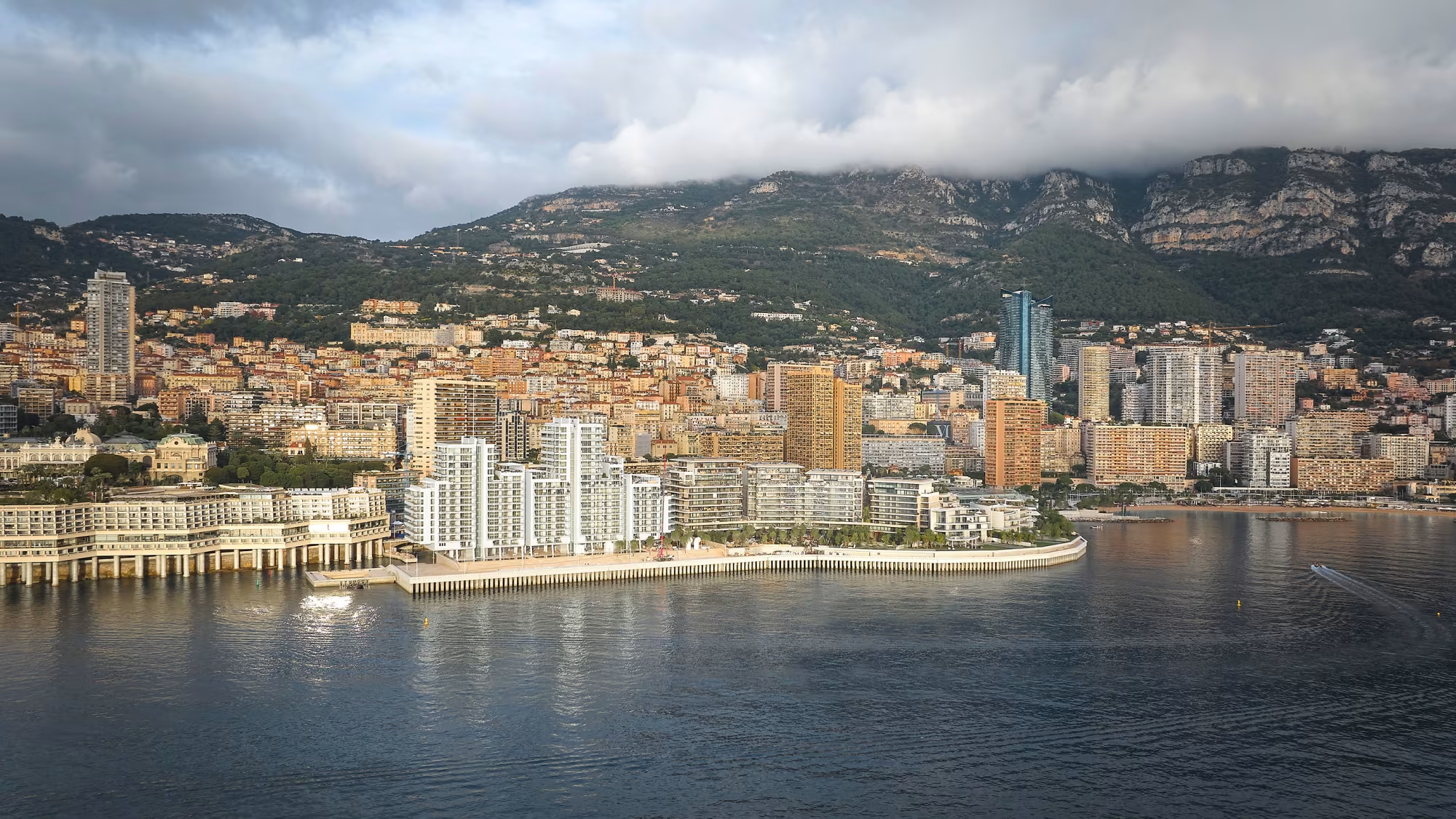
Monaco’s real estate market is not defined by demand alone. It is defined by the near impossibility of creating supply. The country has long occupied a singular position in global real estate. It is not simply one of the world’s most expensive residential markets; it is one of the few markets where physical limits are inseparable from the value of the property itself.
At just 2.08 square kilometres, Monaco is the second-smallest sovereign state in the world after Vatican City. Yet within that compact territory, the Principality has built one of the densest and most valuable urban environments on earth. According to recent IMSEE data reported by Monaco Life, Monaco contained 1,473 buildings as of 31 December 2025, with a combined usable floor area of 3.4 million square metres, more than 60% greater than the country’s entire land surface. 
That figure captures the essence of Monaco’s market: when land cannot expand, value is pushed vertically, technically, and architecturally.
Where Space is the Ultimate Luxury
Most prime real estate markets speak of limited supply that come in cycles. In Monaco, however, supply constraint is it is a permanent condition. The Principality is bordered by France on one side and the Mediterranean on the other. There is no meaningful outward expansion available. New supply can only be created through redevelopment, vertical construction, or rare land reclamation projects. This makes Monaco fundamentally different from other luxury markets such as Dubai, Miami, London, or even Singapore.
In 2025, Monaco’s real estate market recorded 493 transactions, up 5.8% from 2024, with a total sales and resale value of approximately €5.9 billion, according to IMSEE’s Real Estate Observatory. The estimated average price per square metre stood at €57,569 in 2025, only slightly below the 2024 peak. 
For context, even older Monaco stock trades at levels that would be considered ultra-prime elsewhere. Buildings constructed before 1940 still commanded more than €42,000 per square metre, while properties built since 2020 reached an average of €65,602 per square metre.
This is not a market where age automatically creates discount. In Monaco, location, rarity, tenure, views, building quality, and apartment size often matter more than conventional depreciation.
Mareterra: The Exception That Proves the Rule
The most important recent supply event in Monaco has been Mareterra, the new seafront district built on reclaimed land in Larvotto.
Mareterra added roughly six hectares to the Principality and delivered 110 apartments, four townhouses, and 10 villas, according to market reporting. It increased Monaco’s territory by around 3%, a meaningful figure in a country where every square metre is intensely contested. Yet rather than softening the market, Mareterra demonstrated how exceptional new supply in Monaco can reset pricing benchmarks.
Monaco’s total new-build sales volume reached nearly €3.7 billion in 2024, while total sales volume across all property reached €5.8 billion, boosted significantly by Mareterra’s launch. New-build sales rose to 101 transactions in 2024, a 260% increase from 2023, with new-build accounting for 21% of all sales. This is far above Monaco’s usual pattern, where new-build historically represents less than 10% of the market. 
Mareterra was therefore not just another luxury development. It was a once-in-a-generation supply event in a country where significant new projects are exceptionally rare.
Larvotto Moves Further Ahead
Mareterra has also reinforced the pricing power of Larvotto, Monaco’s most valuable seafront district. Larvotto reached an average of €97,563 per square metre in 2024, largely driven by Mareterra. IMSEE’s 2025 data later showed Larvotto exceeding €70,000 per square metre for the first time on the resale market, as recently completed luxury developments began feeding into official market data. 
This matters because Monaco’s districts are small enough that a single major development can materially affect market statistics. Larvotto has relatively limited housing stock, with only 1,263 residences before Mareterra was included in later census data. In larger cities, one project rarely changes the identity of an entire submarket. In Monaco, it can.
The Outlook: Fewer Projects, Higher Standards
The next phase of Monaco real estate will likely place an even greater emphasis on high-quality. Future value growth will depend on a narrow set of factors: prime district positioning, sea views, building quality, apartment size, terrace space, parking, services, energy performance, and rarity within individual buildings. Buyers are becoming more forensic, but the underlying supply-demand imbalance remains firmly in place.
The market may not rise in a straight line every year. Monaco’s average price per square metre moved slightly down in 2025 from the 2024 peak. But the broader picture remains clear: prices are still near historic highs, transaction value remains substantial, and newly delivered prime stock commands a significant premium. 
For UHNW buyers, Monaco continues to offer a combination that few markets can replicate: political stability, security, favourable tax positioning, Mediterranean lifestyle, global connectivity, and extreme scarcity.
For investors, the logic is equally clear. Monaco is not a growth market in the conventional sense. It is a preservation market, where scarcity, governance, and global wealth concentration combine to protect long-term value.
In a world where luxury real estate is increasingly shaped by mobility, security, tax efficiency, and lifestyle, Monaco remains the ultimate constrained market. Every new square metre is difficult to create. Every prime apartment is difficult to replace. Every major development is a market event. That is why Monaco continues to stand apart.
Continue into the portal - curated inventory, search and discovery.